Structure from Sequence: Mechanisms of Tabular Retrieval
Master's Thesis
Overview
My thesis asks a simple question with a surprisingly slippery answer: how do decoder-only language models read a table?
A table is a two-dimensional object. A transformer, however, receives a one-dimensional sequence of tokens: header text, cell text, delimiters, newline tokens, and then a question. The model is never handed a dataframe. If it answers a table lookup question correctly, it has somehow recovered enough of the latent row-column structure from the serialized text to route the question to the right cell.
The central claim of this project is that table lookup is not one monolithic skill. In Llama-3.1-8B, the current evidence points to a rough two-stage pipeline:
- Matching. Early and middle layers match the queried column name and row index back to the corresponding header and index tokens in the table.
- Retrieval. Later layers route attention to the row-column intersection and assemble the final answer.
For example, the table we think of as a two-dimensional object:
| Row | City | Score |
|---|---|---|
| 1 | Boston | 82 |
| 2 | Chicago | 91 |
| 3 | Seattle | 77 |
reaches the model as a text sequence:
| Row | City | Score |
| --- | --- | --- |
| 1 | Boston | 82 |
| 2 | Chicago | 91 |
| 3 | Seattle | 77 |

Question: What is the Score for row 2?
We see the line breaks rendered, but the same input is closer to the 1-dimensional:
| Row | City | Score |\n| --- | --- | --- |\n| 1 | Boston | 82 |\n| 2 | Chicago | 91 |\n| 3 | Seattle | 77 |\n\nQuestion: What is the Score for row 2?
And after tokenization, the model sees only a sequence of integer token IDs. The exact IDs are tokenizer-specific, but structurally the input has become something like:
[91, 4213, 765, 9102, 765, 14877, 765, 198, 91, 4521, 765, 4521, 765, 4521, 765, 198, 91, 220, 16, 765, 15309, 765, 220, 6086, 765, 198, 91, 220, 17, 765, 25342, 765, 220, 8061, 765, 198, 91, 220, 18, 765, 23128, 765, 220, 2813, 765, 271, 14924, 25, 3639, 374, 279, 14877, 369, 2872, 220, 17, 30]
The core tension is that the row-column geometry is not a native part of the input. It has to be reconstructed from delimiters, line breaks, header tokens, and repeated cell positions in the serialized text.
This post is a summary of the thesis as it stands. It serves as research log and a preliminary draft: the main story is already visible, but some experiments are still running and several causal tests remain open.
Why tables?
Language models are often asked to operate over structured data: pasted CSVs, markdown tables, tool outputs, spreadsheet snippets, database rows, JSON objects, logs, and reports. In deployed systems, the model may also have access to tools that parse the data for it. But even when tools help, the model’s native ability to infer structure from a prompt still matters. It determines what the model notices, how it follows references, how robust it is to formatting changes, and when it silently loses track of the object it is supposed to reason about.
Tables are a good minimal case. They are simple enough to define precise lookup tasks, but structured enough that success cannot be explained by local next-token statistics alone. To answer “what is the value in column Score, row 2?”, the model must identify a column axis, identify a row axis, and retrieve the value at their intersection.
That makes tables a useful bridge between two interpretability questions:
- How do models extract latent structure from one-dimensional text?
- Which internal components make that structure behaviorally useful?
The same question appears in richer forms elsewhere. A JSON object is a flat sequence with latent hierarchy. Code is a flat sequence with scope, binding, and control flow. A game transcript is a flat sequence with a latent board state. Tables let us study this broader problem in a controlled setting where the “right answer” is easy to score.
Related work
This project is closest in spirit to mechanistic interpretability work that reverse-engineers model behaviors into circuits. The clearest inspiration is IOI, the Indirect Object Identification circuit in GPT-2 small. IOI showed that a natural language behavior could be explained in terms of specific attention heads and causal interventions, rather than only with aggregate attention visualizations. My table work follows the same ambition: find the heads, characterize their roles, and then intervene on them.
There is also a natural connection to the Transformer Circuits work on induction heads and earlier circuit methodology. Induction heads are a canonical example of models learning a reusable sequence operation: find a previous pattern, then copy or continue it. Table lookup is not the same operation, but it has a similar flavor. The model must find a structural landmark in context, bind a query token to it, and use that binding downstream.
A second related thread studies whether sequence models learn latent world models. In Emergent World Representations, an Othello sequence model develops an internal representation of board state despite being trained only on move sequences. Tables pose a humbler version of the same question: does a decoder trained on text build internal row and column coordinates when all it observes is a serialized table?
Finally, there is a large table-question-answering literature, including specialized table encoders such as TAPAS. Those systems often modify the input representation or architecture to make tables easier to consume. Here the object of study is different: I ask how ordinary decoder-only LLMs, with no explicit table embedding, recover enough table structure from plain text.
The task: structural question answering
The main task is deliberately plain. The model receives a table and a question whose answer is a cell value inside that table:
| Row | Name | Score | City |
|---:|---|---:|---|
| 1 | Ada | 91 | Boston |
| 2 | Bea | 84 | Denver |
| 3 | Cal | 77 | Austin |

Question: What is the value in the 'Score' column, row 2?
Answer:
The correct answer is 84. The answer is determined entirely by the prompt. This makes the task useful for interpretability: success requires in-context structure processing rather than memorized world knowledge.
The current experiments use real tables serialized as markdown or CSV. The main models are Llama-3.1-8B and Qwen-2.5-7B, each in base and Instruct variants, run through TransformerLens so attention patterns and residual activations can be inspected.
I study the task from five angles:
- Behavior. Can the model answer cell-lookup questions exactly?
- Residual probes. Can linear probes decode row, column, or cell-position labels from delimiter-token residual activations?
- Attention alignment. Do heads place more attention than a causal-uniform baseline on same-row or same-column table regions?
- Question routing. When a question is appended, do question-side tokens attend to the correct cell, target column header, target row index, or other structural regions?
- Causal interventions. What happens when candidate matching or retrieval heads are mean-ablated?
What the models can do
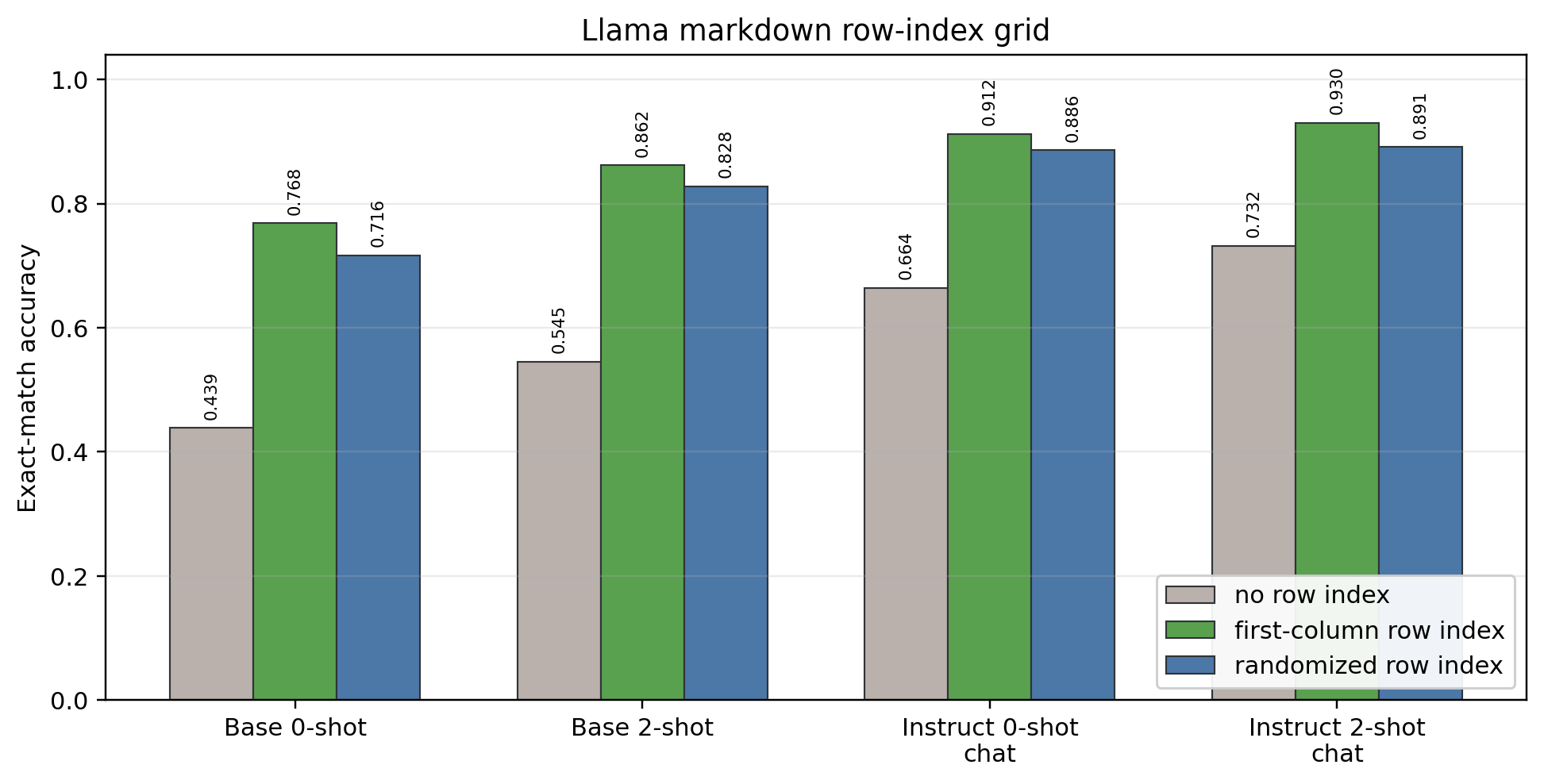
Behaviorally, the task is not solved by default, but the model improves sharply when the prompt gives it an explicit row-index column. In the completed Llama markdown grid, exact-match accuracy looks like this:
| model and prompt | no row-index | first-column row-index | randomized row-index position |
|---|---|---|---|
| Llama base, zero-shot | 0.439 | 0.768 | 0.716 |
| Llama base, 2-shot | 0.545 | 0.862 | 0.828 |
| Llama Instruct, zero-shot chat template | 0.664 | 0.912 | 0.886 |
| Llama Instruct, 2-shot chat template | 0.732 | 0.930 | 0.891 |
First, row indexing matters enormously. Adding the row-index column lifts every cell by about 20 to 33 accuracy points. This is not a tiny prompt polish; it changes the task the model is doing internally.
Second, the row anchor is mostly about content, not first-column position. Moving the row-index column to a randomized position only costs about 3 to 5 points relative to keeping it first.
Third, markdown is consistently easier than CSV. In the earlier format-level aggregates, markdown beats CSV by about 7 points for Llama base (0.550 vs 0.483) and 12 points for Llama Instruct (0.678 vs 0.563). Those “pooled” runs are not a separate condition; they are aggregate format comparisons over the evaluated real-table questions. Whitespace-only markdown also hurts: removing pipe delimiters drops Llama Instruct zero-shot with row-index from 0.912 to 0.873.
From row counting to row matching
The row-index result changed how I think about the task. Without an explicit index column, “row 7” means “count down to the seventh data row.” With an index column, “row 7” means “match the token 7 in the question to the token 7 in the table’s index column.” That is a very different computation.
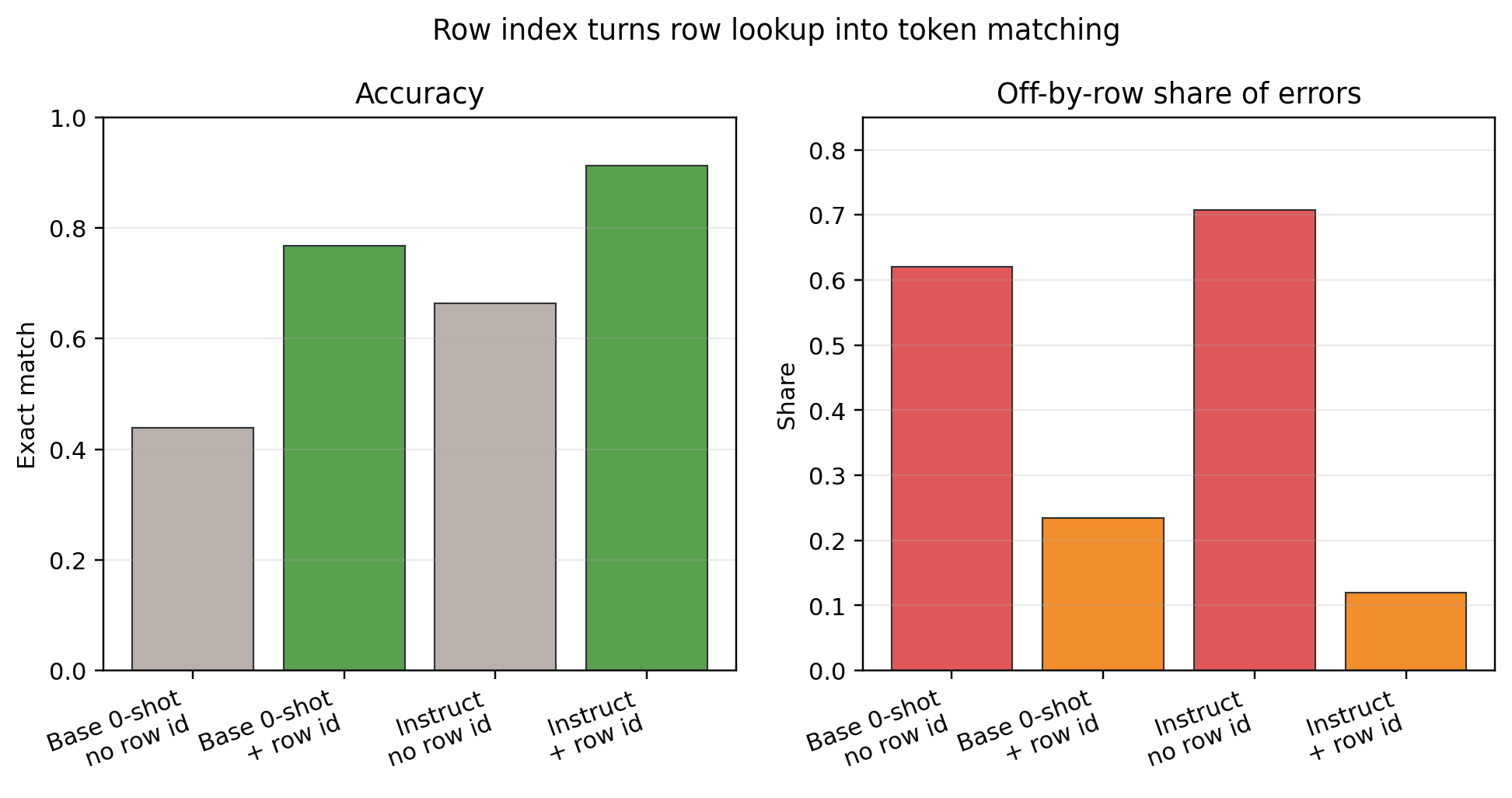
The error analysis supports this distinction. Define off_by_row as an error where the model retrieves from the right column but the wrong row. Without a row-index column, this is the dominant failure mode:
| config | exact | off_by_row (% of errors) | wrong_col_same_row | not_in_table |
|---|---|---|---|---|
| base zero-shot, no row-index | 0.439 | 62.1% | 4.0% | 25.9% |
| base zero-shot, + row-index | 0.768 | 23.5% | 17.3% | 41.0% |
| Instruct, no row-index | 0.664 | 70.7% | 5.6% | 14.5% |
| Instruct, + row-index | 0.912 | 12.0% | 32.0% | 30.1% |
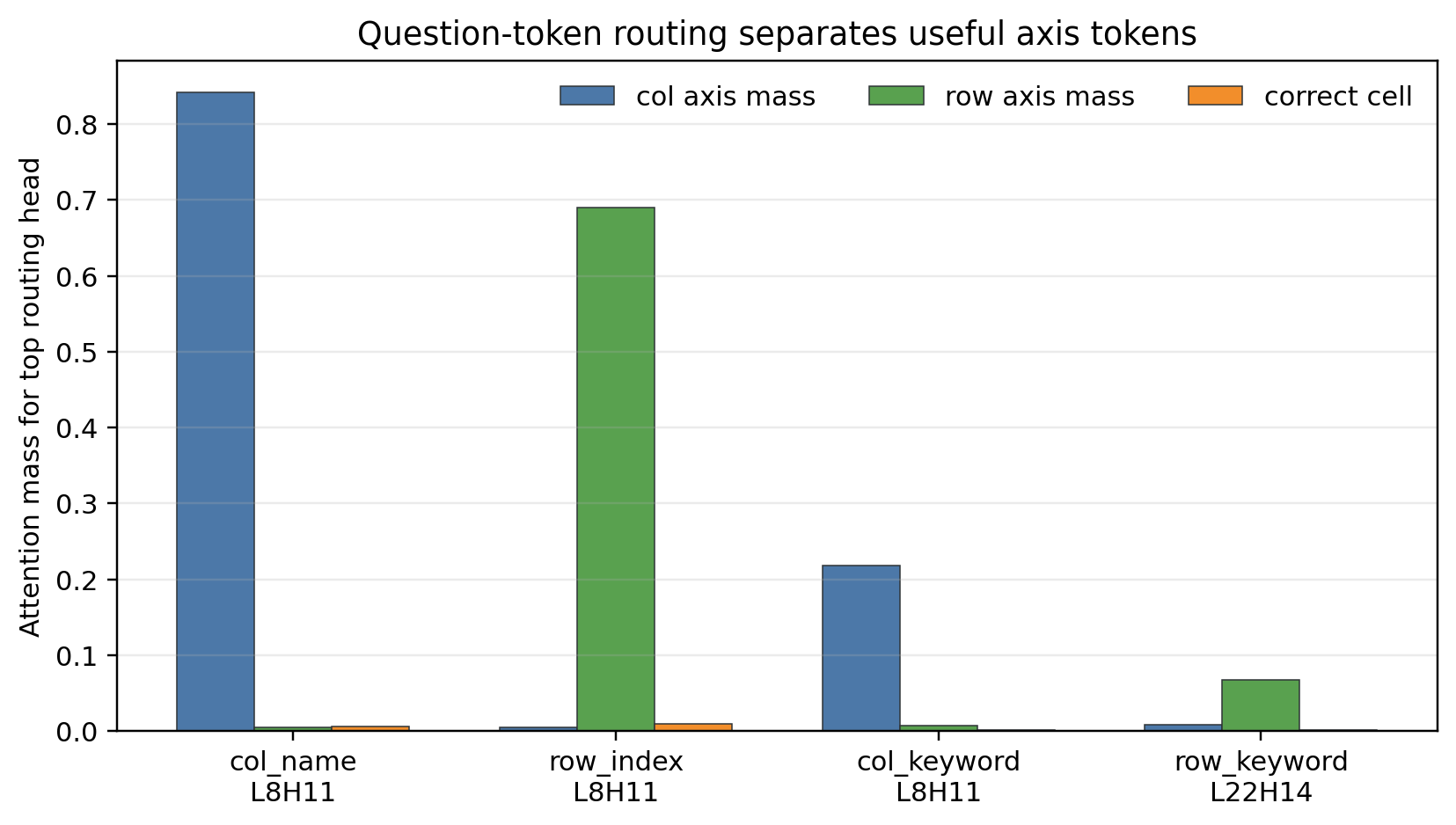
Mechanistically, this fits the token-routing results. The question token group corresponding to the row keyword itself has almost no useful routing signal: row_keyword -> header peaks around 0.06. The row number, by contrast, can route to the row-index column. The model is not robustly finding rows by counting or by a natural row name; it is using the explicit index column as a load-bearing anchor.
A proposed table-reading pipeline
The working model is that cell lookup decomposes into a pipeline. The stages are not perfectly modular, but they separate strongly by layer depth.
flowchart LR
  A[Serialized table tokens] --> B[Delimiter and axis landmarks]
  Q[Question tokens] --> C[Column-name and row-index matching]
  B --> C
  C --> D[Late retrieval to target cell]
  D --> E[Answer token]
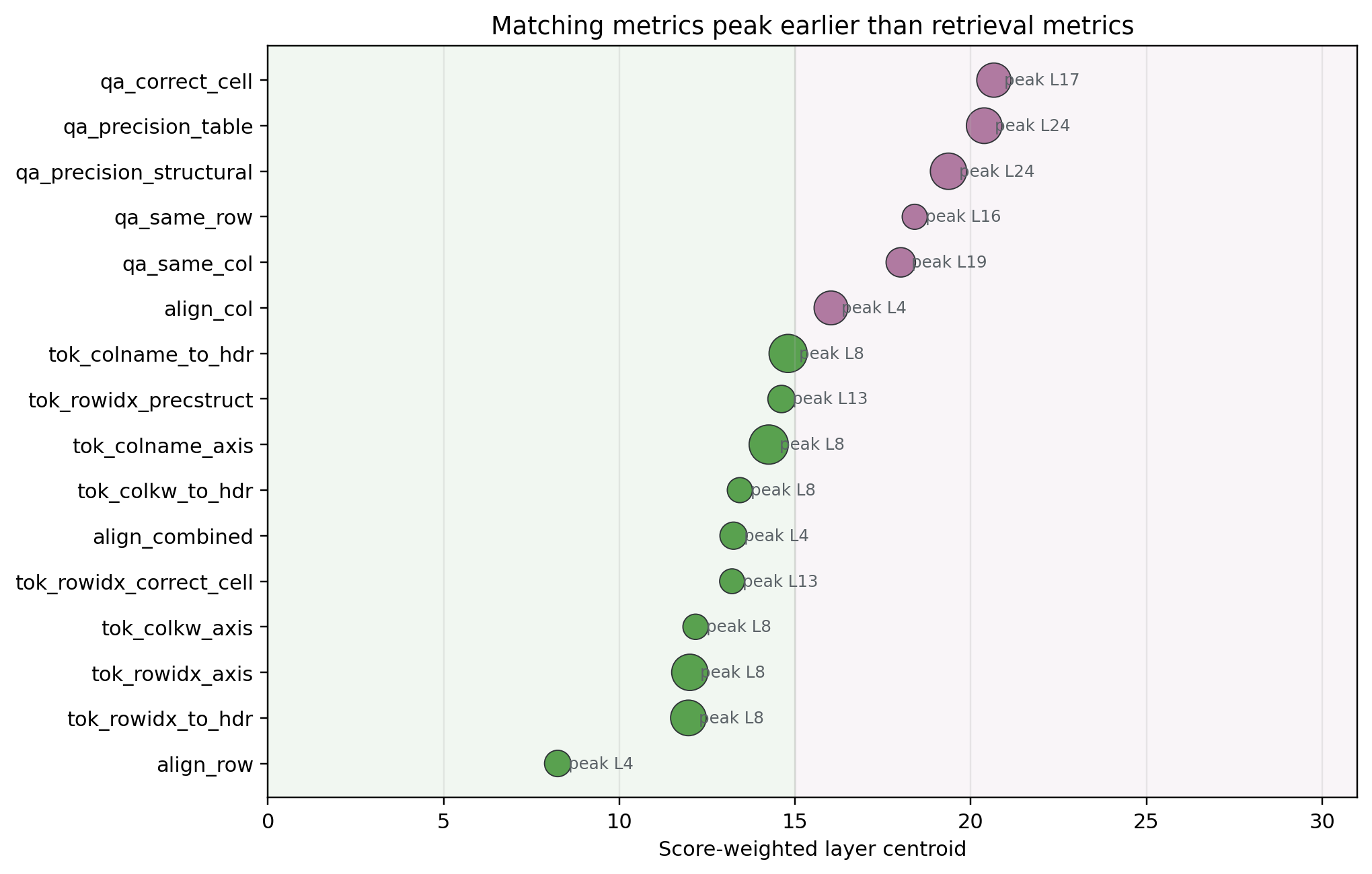
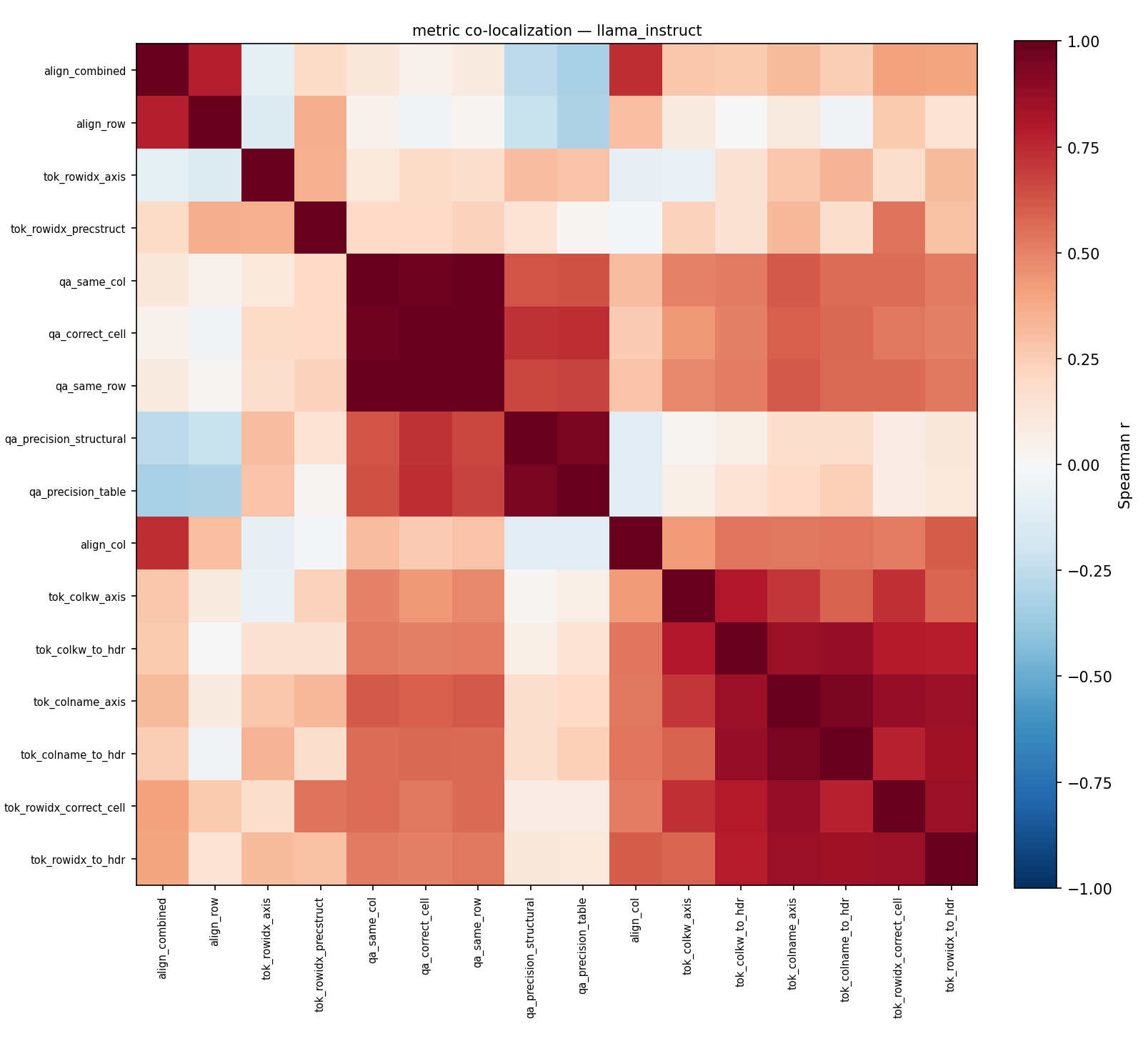
The score-based circuit map supports this depth-wise separation. In Llama Instruct on markdown tables with row indices, matching metrics peak in early and middle layers. Retrieval metrics peak later:
| stage | representative metrics | peak layers | score-weighted centroid |
|---|---|---|---|
| Matching | column-name -> header, row-index -> header, row/column alignment | L4-L8 | about L8-L15 |
| Retrieval | correct-cell attention, structural precision, table precision | L17-L24 | about L18-L21 |
The important point is not that there are exactly two clean modules. The important point is that the model appears to first establish useful structural bindings, then use those bindings later when generating the answer.
Stage 1: establishing column structure
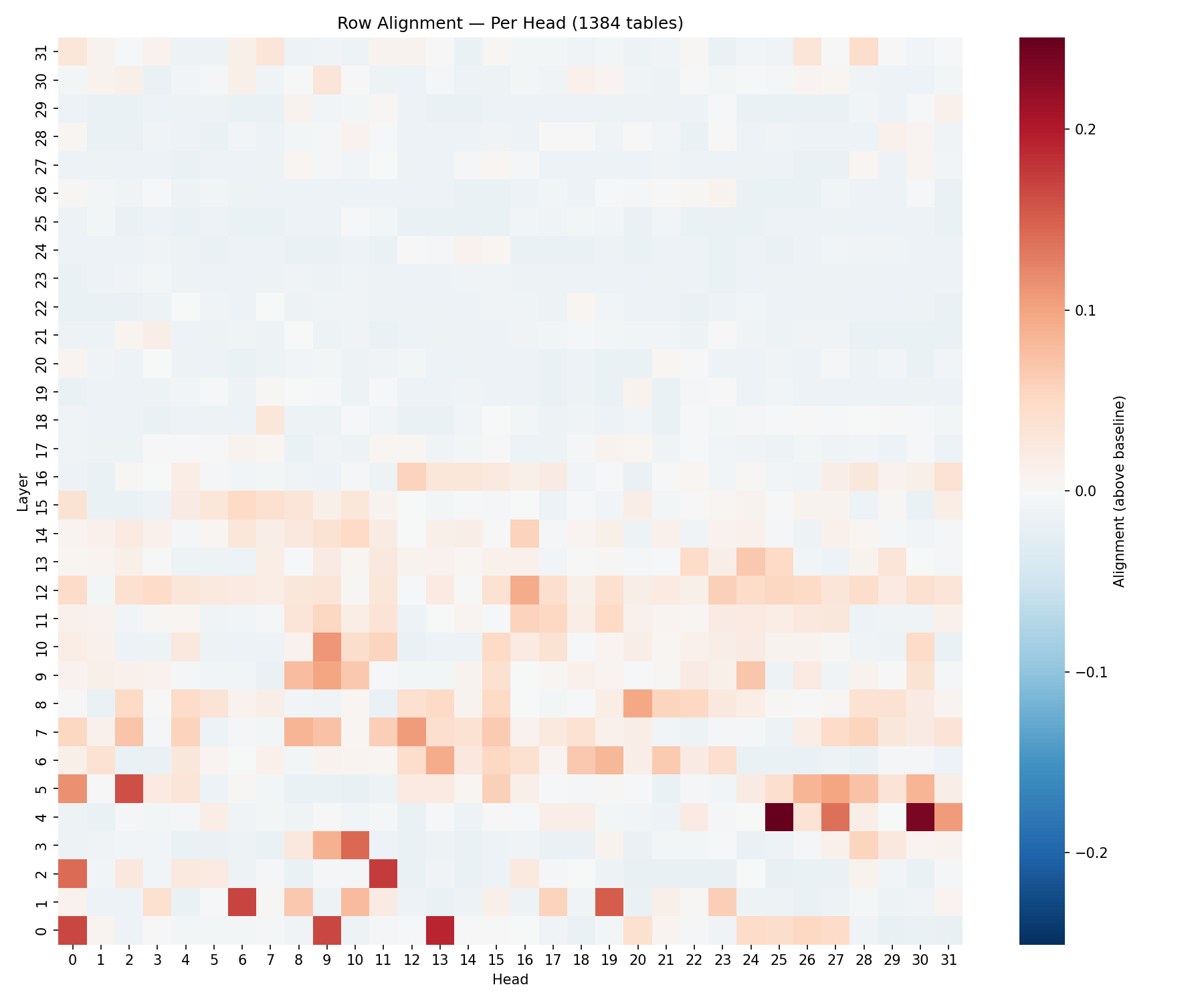
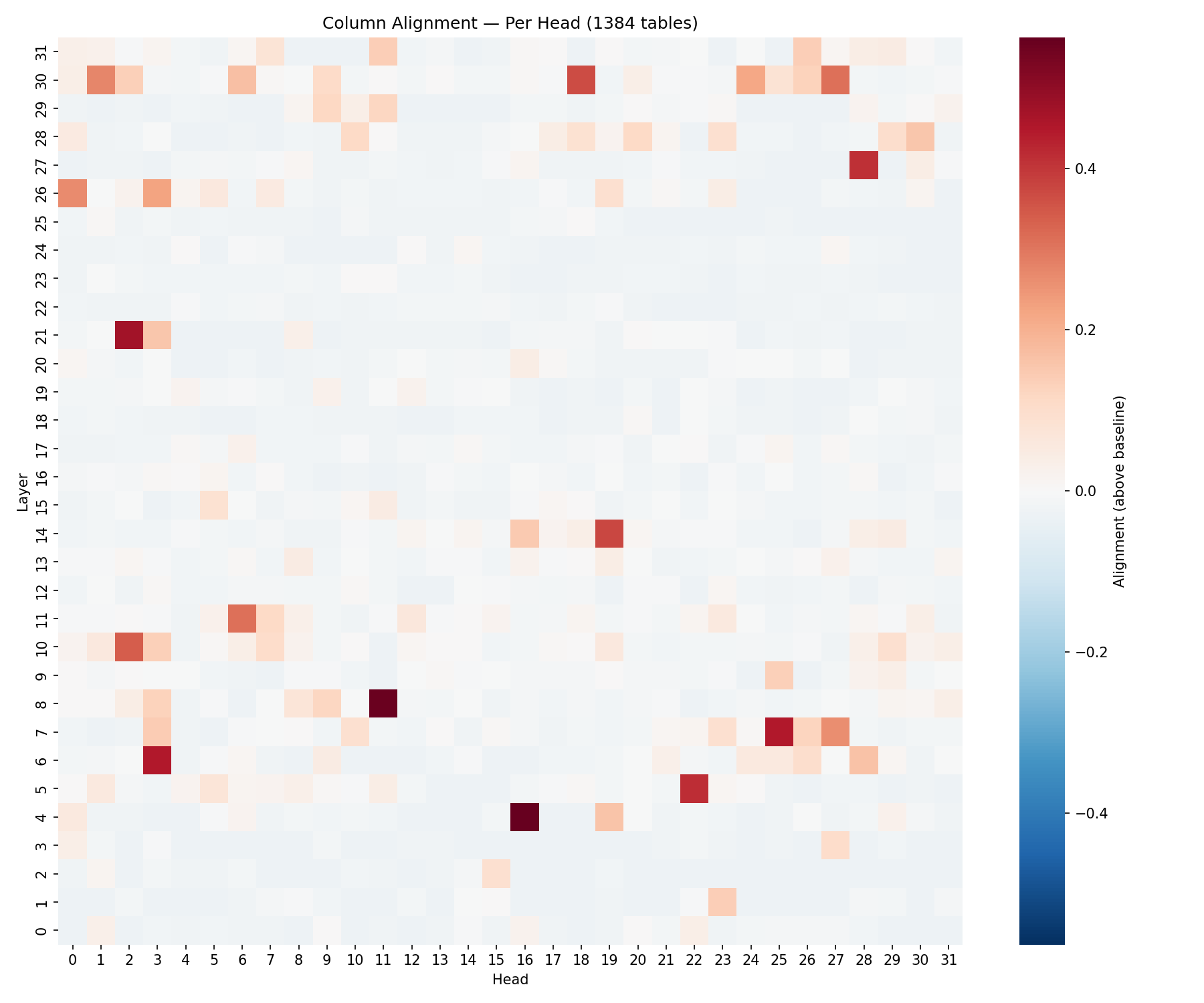
Before the model can answer a question, it needs a way to represent table axes. The attention-alignment analysis asks whether heads attend more than a causal-uniform baseline to same-row or same-column regions. This is deliberately weaker than “the head answers the question”; it measures whether the head respects table geometry at all.
Several heads show strong column alignment. In Llama Instruct markdown runs, heads such as L4H16, L8H11, L14H19, and L10H2 place unusually high mass along the column axis. The same analysis also finds row-aligned heads, though row structure is much less useful behaviorally unless a row-index column is present.
This is the first place where the “structure from sequence” story becomes visible. The model does not receive a column identifier. But delimiter tokens, header tokens, and repeated row formatting create landmarks that some heads can use as implicit coordinates.
Stage 2: matching the question to the table
Once a question is appended, the model must bind words in the question to specific table landmarks. This is where the most interpretable head story appears.
The head L8H11 is currently the best candidate for a matching hub. In Llama Instruct, it scores highly on both axes:
| head | role | representative scores |
|---|---|---|
| L8H11 | matching hub | colname -> header 0.78, rowidx -> header 0.65, align_col 0.56 |
| L4H16 | column matching | colname -> header 0.55, align_col 0.56 |
| L14H19 | column matching | colname -> header 0.67, rowidx -> header 0.42 |
| L8H1 | column matching | colname -> header 0.65 |
| L5H8/L5H9/L5H11 | row-index matching cluster | rowidx -> header about 0.26-0.47 |
The distinction between the row token groups matters. The token “row” is not very useful. The row index itself is. The model seems to route the numeric row token to the explicit index column and route the column-name tokens to the header row.
Stage 3: retrieving the target cell
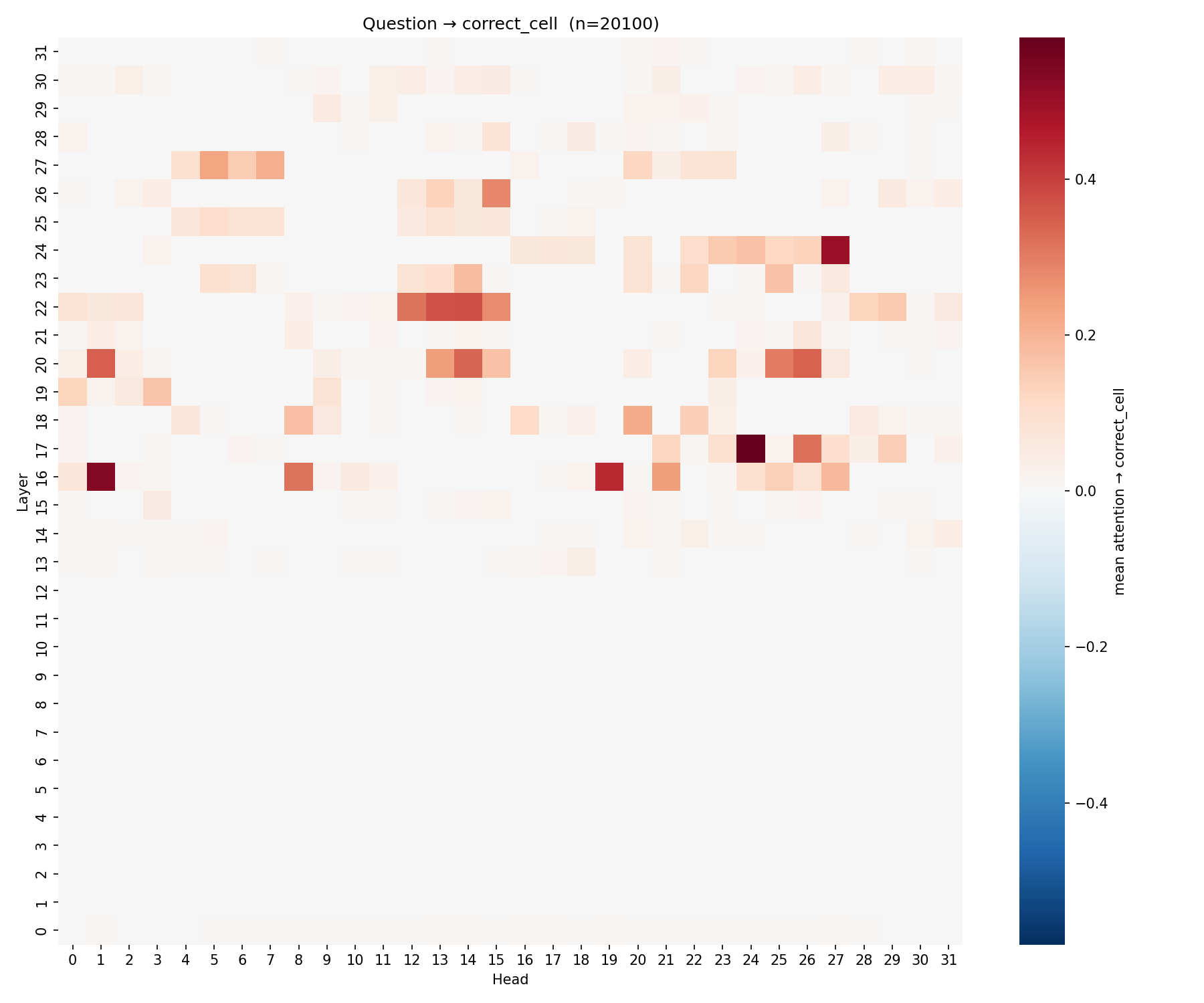
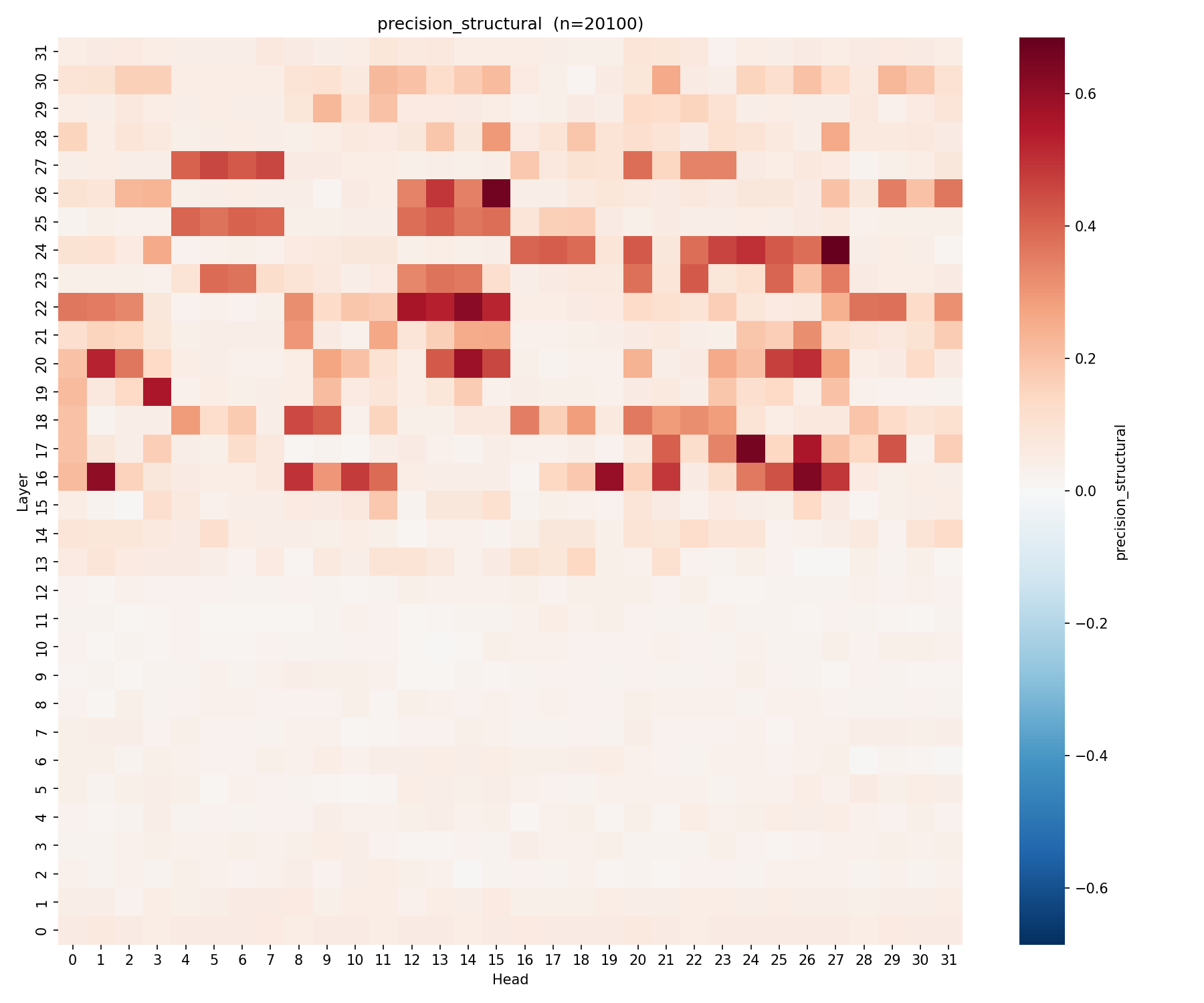
The retrieval stage appears later. The strongest correct-cell and structural precision heads in Llama Instruct live around layers 16-24:
| head | representative scores |
|---|---|
| L17H24 | correct_cell 0.58, precision_structural 0.65 |
| L16H1 | correct_cell 0.53, precision_structural 0.61 |
| L24H27 | correct_cell 0.50, precision_structural 0.69 |
| L16H19/L16H8 | correct_cell 0.32-0.44 |
| L22H12/L22H13/L22H14 | correct_cell 0.32-0.37 |
These heads are less cleanly “the answer head” than one might hope. Correct cell attention is diffuse, and attention is not the whole computation. Still, the depth profile is robust: metrics that directly involve the target cell peak later than metrics that involve matching the query to headers and row indices.
Comparing Base and Instruct
Instruction tuning improves the native chat setup, but the clean matched-prompt comparison is more subtle. When Llama base and Llama Instruct both see the same base-style 2-shot text prompt with row indices, exact match changes only from 0.862 to 0.876: a +0.014 gain.
The updated grid separates three levers that were previously tangled together:
| comparison | exact-match change | effect |
|---|---|---|
| prompt format, 2-shot text prompt -> 2-shot chat template | 0.876 -> 0.930 | +0.054 |
| shots, chat-template 0-shot -> chat-template 2-shot | 0.912 -> 0.930 | +0.018 |
| weights, base -> Instruct under matched 2-shot text prompt | 0.862 -> 0.876 | +0.014 |
That does not mean instruction tuning is irrelevant. It means most of the apparent Instruct advantage in this setting comes from prompt format, with a smaller contribution from in-context examples and an even smaller clean contribution from tuned weights. Mechanistically, the head-level comparison suggests a more specific story: matching is mostly pretrained, while retrieval shifts more under instruction tuning.
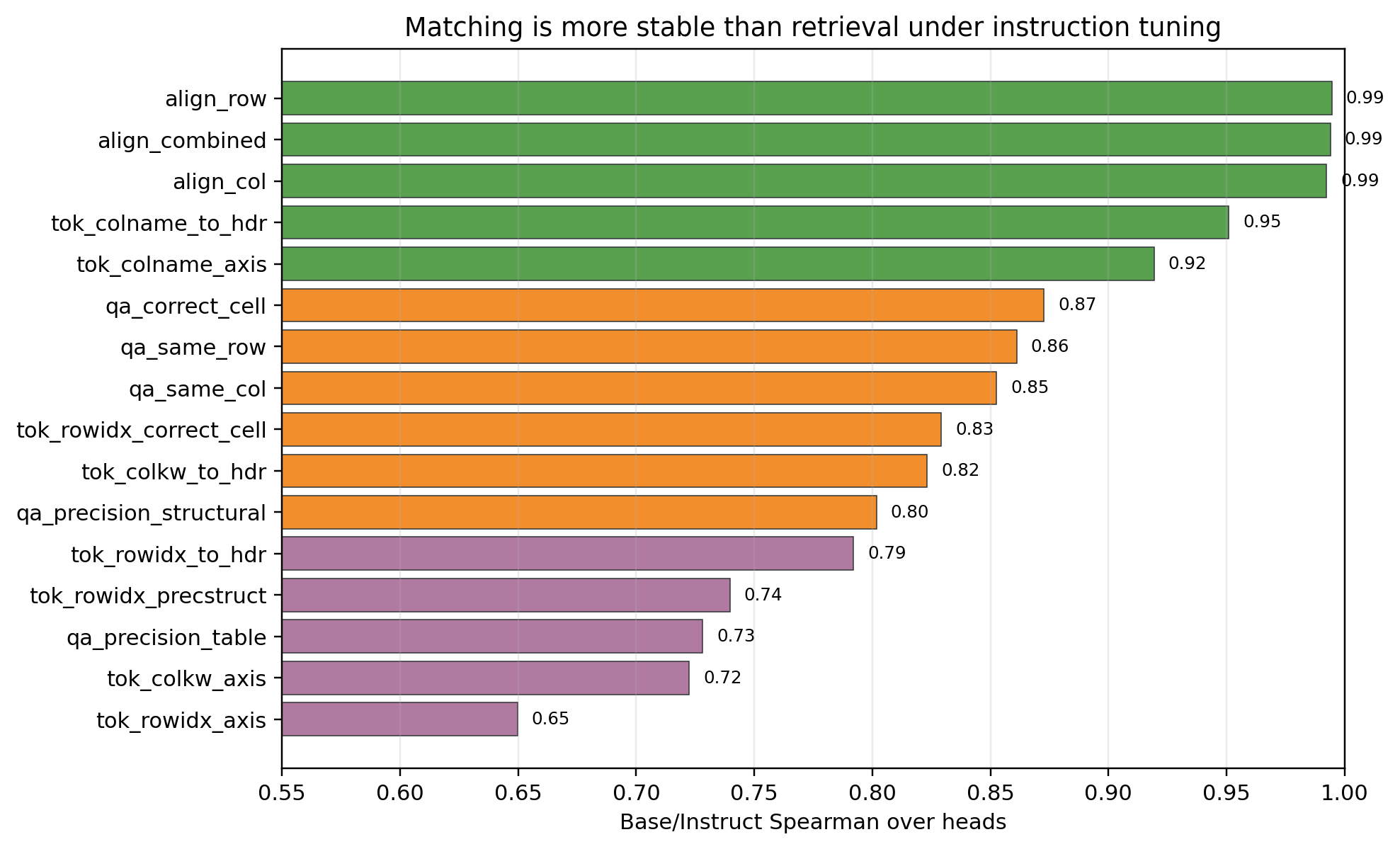
Per-metric Base/Instruct Spearman correlations over all 1024 Llama heads:
| metric | Spearman |
|---|---|
| align_row / align_combined / align_col | about 0.99 |
| column-name -> header | 0.95 |
| column-name axis mass | 0.92 |
| correct-cell attention | 0.87 |
| structural precision | 0.80 |
| table precision | 0.73 |
| row-index axis mass | 0.65 |
The near-identity of alignment and column-name matching heads suggests that much of the table-axis machinery is already present in the base model. The lower stability of retrieval and row-index routing suggests these later, answer-facing computations are more affected by instruction tuning and prompt format.
What goes wrong?
There are two main behavioral failure stories.
The first is row tracking. Without a row-index column, the model often retrieves from the right column but the wrong row. This is the off-by-row failure described above, and it is exactly the failure that row indices reduce.
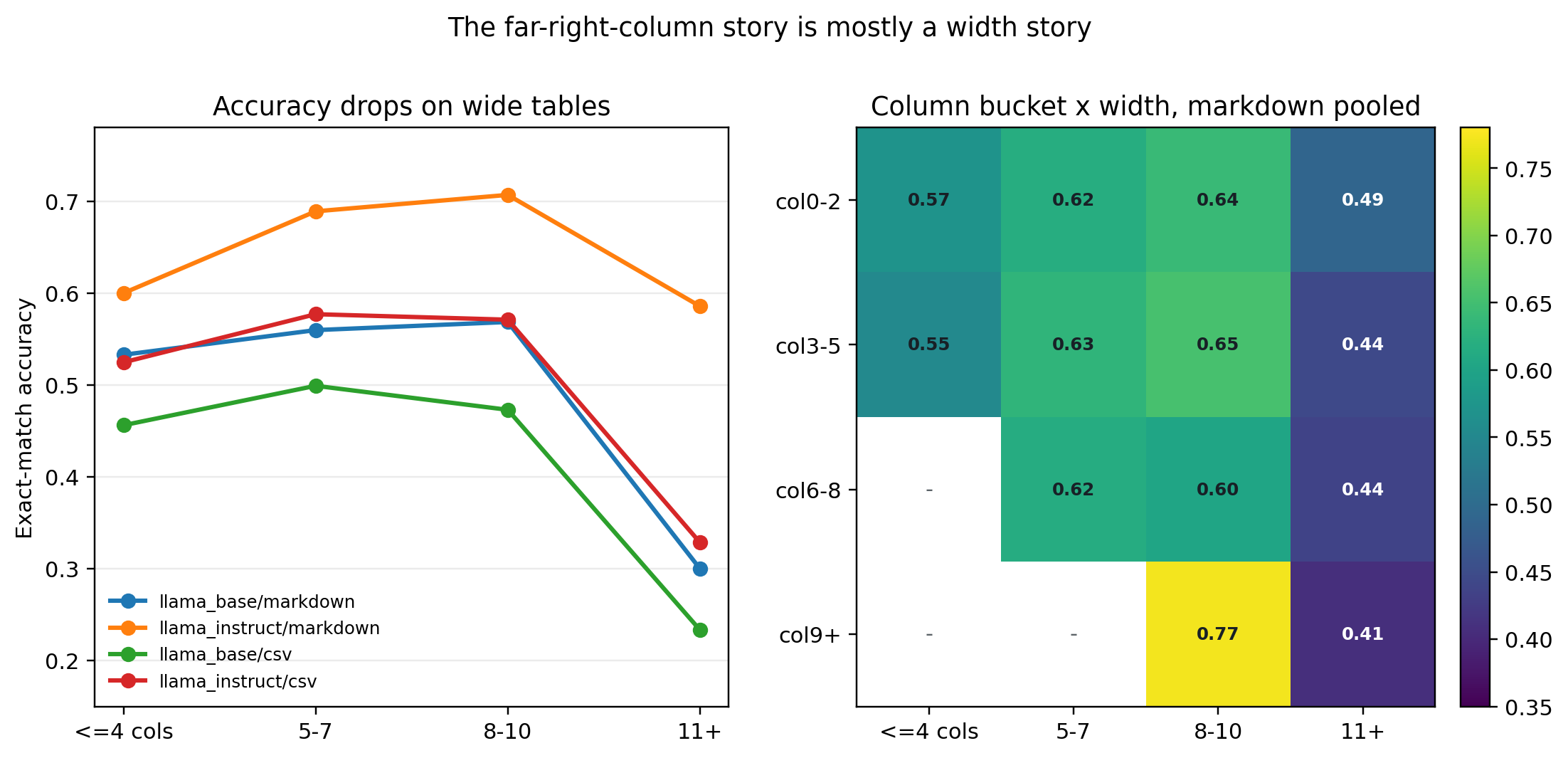
The second is wide-table collapse. At first glance, accuracy appears to fall for far-right columns. But after controlling for table width, the story changes: the hard cases are not far-right columns; they are wide tables.
At a fixed width, accuracy is roughly flat across column position. The real drop appears when tables have 11 or more columns:
| format/model | typical mid-width accuracy | 11+ column accuracy |
|---|---|---|
| Llama base, markdown | about 0.57 | 0.30 |
| Llama Instruct, markdown | about 0.71 | 0.59 |
| Llama base, CSV | about 0.50 | 0.23 |
| Llama Instruct, CSV | about 0.58 | 0.33 |
The regression view points the same way. Width is a stronger column-side error driver than absolute column index, while row depth is the strongest within-table driver overall.
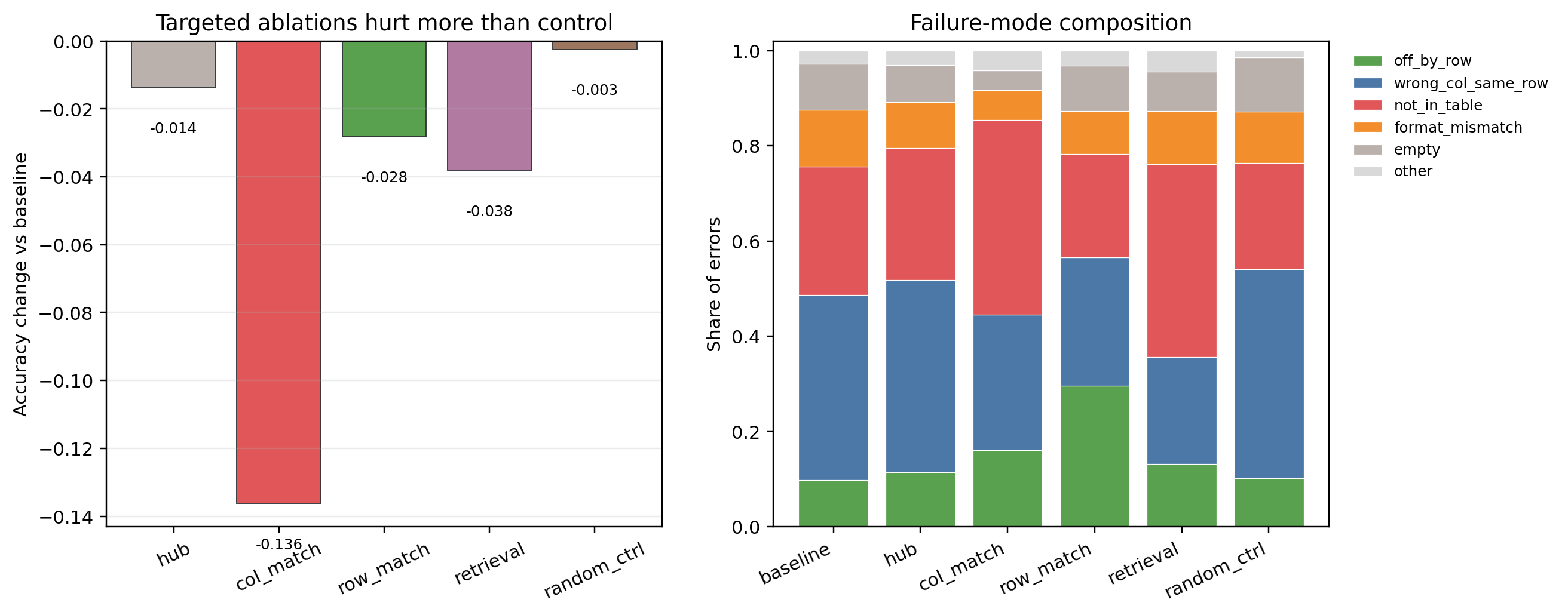
The first causal interventions sharpen the story. In Llama Instruct with row-indexed markdown tables, mean-ablation gives:
| ablated set | heads | exact | delta acc | main shift |
|---|---|---|---|---|
| baseline | none | 0.910 | - | - |
| hub | L8H11 | 0.896 | -0.014 | small change |
| column matching | L4H16, L14H19, L8H1, L10H2 | 0.774 | -0.136 | not_in_table rises |
| row matching | L5H8, L5H9, L5H11, L14H17 | 0.882 | -0.028 | off_by_row rises |
| retrieval | L17H24, L24H27, L16H1 | 0.872 | -0.038 | not_in_table rises |
| random control | 12 random heads | 0.908 | -0.003 | inert |
The row-matching ablation is the cleanest mechanism-to-behavior link: off_by_row errors rise from 9.7% to 29.6% of errors. The column-matching ablation causes the biggest accuracy drop, but its dominant new failure is not “wrong adjacent column.” Instead, the model often leaves the table entirely. That suggests column matching may be a prerequisite for the retrieval stage to stay anchored to the table region at all.
The base-model replication adds an important caution. On Llama base, 2-shot, row-indexed markdown, the baseline is already much more fragile: 34.4% of its errors are off-by-row, compared with 9.7% for Instruct. Column matching still replicates as the dominant bottleneck, but the row-matching specificity does not cleanly replicate because the random control is no longer inert:
| ablated set | exact | delta acc | off_by_row share |
|---|---|---|---|
| baseline | 0.880 | - | 34.4% |
| column matching | 0.649 | -0.231 | 46.3% |
| row matching | 0.806 | -0.074 | 44.5% |
| retrieval | 0.823 | -0.058 | 35.6% |
| random control | 0.839 | -0.041 | 45.5% |
So the clean causal row-tracking claim is currently strongest in the robust Instruct regime. In the base 2-shot regime, many perturbations seem to tip an already-marginal row-tracking process into off-by-row errors.
What formatting helps?
The mechanistic picture gives practical formatting advice:
- Include a row-index column. This turns row lookup into token matching and removes the dominant off-by-row failure. It does not have to be the first column to help; randomized index position retains most of the gain.
- Prefer markdown over CSV, and keep the pipes. Markdown gives the model stronger visual and token-level landmarks; removing pipe delimiters causes a small but measurable drop.
- Keep tables narrow when possible. The current failure threshold is around 11 or more columns; position within a fixed-width table matters much less than width itself.
- Use stable, explicit headers. The column-name matching heads need a clear header token to bind to.
- Ask with the same surface form used in the table. If the table says
Score, ask forScore, not a paraphrase, unless you have separately tested semantic header matching.
These are not just prompt-engineering guidelines; each one corresponds to a proposed internal operation: make row identity matchable, make columns landmarked, and keep the retrieval region small enough that later heads can stay locked onto the table.
Current hypotheses
Here is the current thesis story in hypothesis form.
- Table lookup is a two-stage pipeline. Early/mid layers match the question’s column name and row index to table landmarks; late layers retrieve the target cell.
- Matching is mostly pretrained; retrieval is more instruction-sensitive. Alignment and column-name matching are highly stable across base and Instruct, while retrieval and row-index routing shift more. Behaviorally, prompt format is the largest measured Instruct lever so far: +0.054 for 2-shot text prompt -> 2-shot chat template, compared with +0.018 for adding chat-formatted examples and +0.014 for tuned weights under a matched prompt.
- L8H11 is a matching hub. It is the clearest single head that routes both column-name and row-index information to table landmarks.
- Rows are found by index, not by row keyword. The row-index column is the load-bearing row anchor; the word “row” itself carries little routing signal.
- Wide tables, not far-right columns, drive the column-side collapse. Absolute column position is much less important once table width is controlled.
- Matching heads are causally necessary in the robust Instruct regime. Ablating row-index matching heads selectively increases off_by_row errors; ablating column-matching heads causes a much larger accuracy drop and often sends the model off-table. The base 2-shot replication keeps the column bottleneck but shows that row-specific attribution depends on a stable behavioral regime: when baseline row tracking is already fragile, even random head ablations can increase off-by-row errors.
Current evidence and open questions
The evidence is strongest for the Llama Instruct markdown row-index setting, where behavior, attention routing, token-level routing, and ablation all line up. As of July 8, 2026, the Llama markdown behavioral grid now includes no-index, first-column row-index, and randomized-position row-index conditions for base and Instruct. The story is still weaker where only a subset of analyses has finished, especially across Qwen, CSV, and intervention variants.
The most important open questions are:
- Can activation patching localize the computation more cleanly than mean-ablation? Mean-ablation is a blunt tool. Patching on the robust Instruct setting could test whether the matching heads actually carry the row/column binding information needed downstream.
- Does the two-stage story replicate across Qwen and CSV? Early Qwen and CSV results are suggestive, but the complete aligned grid is still in progress.
- How much of retrieval is attention, and how much is MLP/residual computation? Correct-cell attention is useful but diffuse; a complete circuit likely needs value vectors, MLPs, and residual-stream patching.
- Can head selection be made blind? The current head-vote and ablation choices are informed by ground-truth metrics. A stronger claim would select heads on one split and test causal effects on another.
- Can the remaining prompt-format corner be isolated? The completed grid separates chat-template format, chat-formatted examples, and tuned weights for the main row-index setting, but an Instruct few-shot-text zero-shot run would isolate shot effects away from the chat template.